Vision for Learning
Mt Maria College offers a tailored program of study from year 7-12 underpinned by our Marist values - Presence, Family Spirit, Love of Hard Work and Simplicity. The College offers programs within two distinct phases of schooling - Middle Years (7-9) and Senior Years (10-12). This enables Mt Maria College to:
- Enhance and develop curriculum and support structures appropriate the students' developmental and intellectual needs.
- Expand specialist facilities, tuition, and support necessary to complement the child's growth and development.
Our Commitment to the Alice Springs (Mparntwe) Education Declaration
At Mt Maria College, we proudly affirm our commitment to the principles and goals outlined in the Alice Springs (Mparntwe) Education Declaration (Education Council 2019). We strive to provide an education of excellence that promotes excellence and equity, ensuring every student can achieve their full potential. We are dedicated to fostering confident and creative individuals, successful lifelong learners, and active, informed community members.
We recognize and celebrate the rich cultural heritage of the Aboriginal and Torres Strait Islander peoples, particularly the Arrernte people, the traditional custodians of Alice Springs (Mparntwe). Our school is committed to embedding their cultures, knowledge, and histories into our educational practices, supporting all students to imagine, discover, and unlock their potential.
Together, we aim to create a supportive and inclusive learning environment that meets the diverse needs of all learners, preparing them for the challenges and opportunities of the 21st century.
Belief about Learning
Promoting excellence and equity, Mt Maria College supports a student-centred, holistic approach to education, recognising that students have different strengths, needs and backgrounds. We affirm our commitment to the importance of meeting these individual needs, with a focus on student progress and growth, regardless of the startiing point.
Our educational goals have as a specific focus the building of students' capacity to develp empathy-enhanced skills in collaboration, creativity, critical thinking, and communication. We work to unlock the potential of each student, aspiring to extend their potential and develop agency for their learning, to be active and informed members of the community.
We affirm education's role in developing young people's resilience and mental wellbeing, enabling them to confidently recognise, adapt to, and manage change.
In making our vision a reality, we have high expectations of our students and staff. We support all students - irrespective of students' background, relative advantage, or cultural heritage - to develop a growth mindset to enable their progress into self-directed, confident, and creative, lifelong learners. Our teachers aspire to be positive, enthusiastic, and engaging, to facilitate differentiated, quality teaching and learning experiences which will engage and motivate our students.
Pedagogical Framework
Our school-wide Pedagogical Framework translates our vision into everyday practice and is based on the belief that every student can learn. It provides a consistent, evidence-based set of guidelines and resources to support our teachers in delivering high quality teaching that maximises learning for all students.
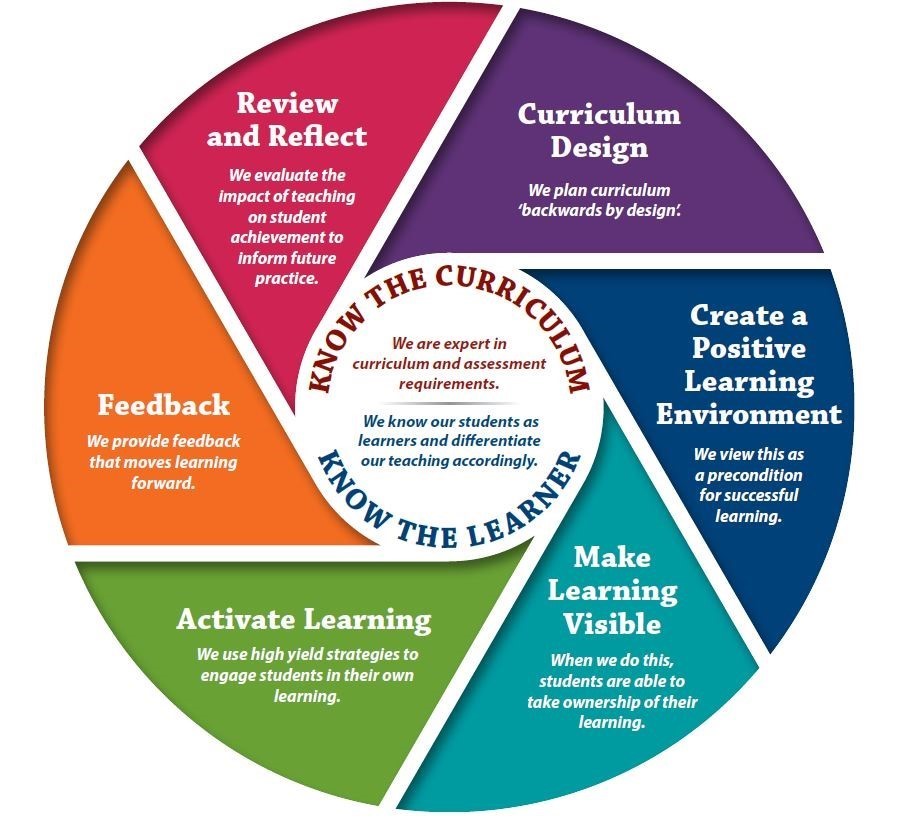
We foster a strong academic culture by:
- Utilising innovative, high-quality and proven teaching practices
- Fostering a growth mindset
- Setting high expectations of teachers and students
- Differentiating learning experiences
- Celebrating student success
Mt Maria College Curriculum Delivery Plan (PDF 1MB)
Subject Offerings
© Brisbane Catholic Education, Mt Maria College, Mitchelton (2025)